Media reports
Wirtschaft Regional November 2011 – Innovation Award
"Innovation Award Ostwürttemberg"/ "More top-class submissions than ever before".
![[Translate to English:]](/fileadmin/user_upload/_processed_/6/d/csm_Banner_WR_Noch_nie_waren_so_viele_Hochkaraeter_unter_den_Bewerbern_877a123f0a.jpg "[Translate to English:]")
Innovation Award Ostwürttemberg awarded for the eleventh time in Heidenheim – presenters praised the perfectly realized ideas and patents of the winners
Winfried Hofele and Sascha Kurz
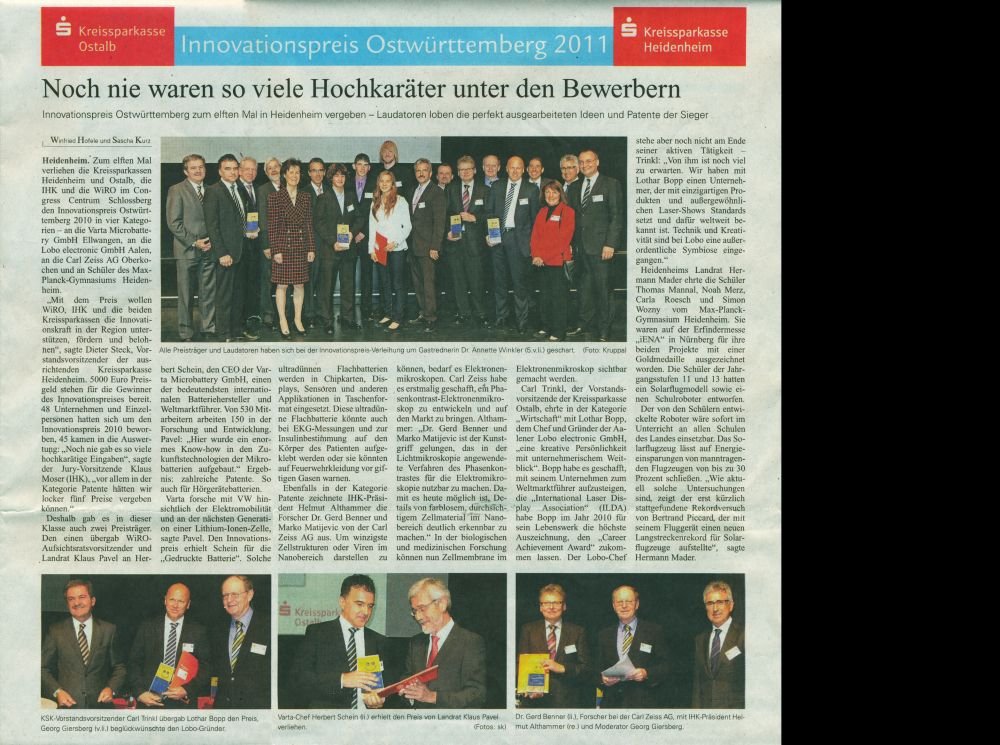
Heidenheim: For the eleventh time, the Kreissparkassen Heidenheim and Ostalb, the IHK and the WiRO presented the Innovation Award Ostwürttemberg 2010 in four categories in the Congress Centrum Schlossberg to Varta Microbattery GmbH Ellwangen, to Lobo electronic GmbH Aalen, to Carl Zeiss AG Oberkochen, and to students of the Max-Planck-Gymnasium Heidenheim.
“With this award, WiRO, IHK and the two Kreissparkassen want to support, promote and reward innovative performances within the region,” Dieter Streck, chairman of the board of the hosting Kreissparkasse Heidenheim, said. The winners of the innovation award are rewarded with EUR 5,000 in prize money. 48 companies and individuals had entered the Innovation Award 2010, with 45 making the shortlist. “Never before have we had so many high-quality submissions,” jury chairman Klaus Moser (IHK) said, “in the category patents, we could have easily awarded five trophies.”
Therefore, there were two winners in this category. One award was presented by WiRO’s chairman of the supervisory board and district administrator Klaus Pavel to Herbert Schein, CEO of Varta Microbattery GmbH, one of the most important international battery manufacturers and a global market leader. 150 of the 530 employees are working in research and development. Pavel: “Here, an enormous know-how in future technologies of micro batteries was developed.” The result: Numerous patents, including for batteries for hearing aids.
In cooperation with VW, Varta was researching in the field of electric mobility and the next generation of a lithium ion cell, Pavel said. Schein received the innovation award for the “printed battery”. Such ultra-thin flat batteries are used in chip cards, displays, sensors and other pocket-sized applications. This ultra-thin flat battery may even be glued to the body of a patient for ECG measurements or for insulin determination or it may warn of toxic gases on the clothing of firefighters.
Another award in the category patents was presented by IHK president Helmut Althammer to the researchers Dr. Gerd Benner and Marko Matijevic from Carl Zeiss AG. In order to visualize microscopic cell structures or viruses on a nanoscale, electron microscopes are required. Carl Zeiss was the first to develop and introduce a phase contrast electron microscope to the market. Althammer: “Dr. Gerd Benner and Marko Matijevic managed to make the process of phase contrast, previously used in light microscopy, applicable to electron microscopy. With this, it is now possible to make details of colorless, transparent cell material on a nanoscale clearly visible.” Now, cell membranes can be made visible under an electron microscope in biological and medical research.
In the category “Economy”, Carl Trinkl, chairman of the board of Kreissparkasse Ostalb, honored Lothar Bopp, the CEO and founder of the Aalen-based Lobo electronic GmbH, “a creative individual with an entrepreneurial vision.” Bopp had managed to rise to the position of market leader with his company, having received the highest award of the “International Laser Display Association” (ILDA), the “Career Achievement Award”, for his life’s work in 2010. However, Lobo’s CEO is still not at the end of his active work. Trinkl: “We can still expect a lot from him. With Lothar Bopp, we have an entrepreneur who is setting standards with unique products and exceptional laser shows, which have made him famous around the world. At Lobo, technology and creativity have entered an extraordinary symbiosis.”
Hermann Mader, the disitrict administrator for Heidenheim, honored the students Thomas Mannal, Noah Merz, Carla Roesch and Simon Wozny of the Pax-Planck-Gymnasium Heidenheim. At the inventor fair „iENA“ in Nuremberg, they had been awarded a gold medal for their two projects. The year 11 and 13 students had designed a solar airplane model and a school robot. The robot developed by the students could immediately be used in lessons at all schools of the state. The solar plane suggests energy savings of up to 30 percent for manned airplanes. “The recent record attempt of Bertrand Piccard, who set a new long-distance record for solar planes with his flying machine, shows topicality of such studies,” Hermann Mader said.