Media reports
Physik Journal July 2010
"The Magic of Light"
How laser shows fascinate with seemingly supernatural impressions.
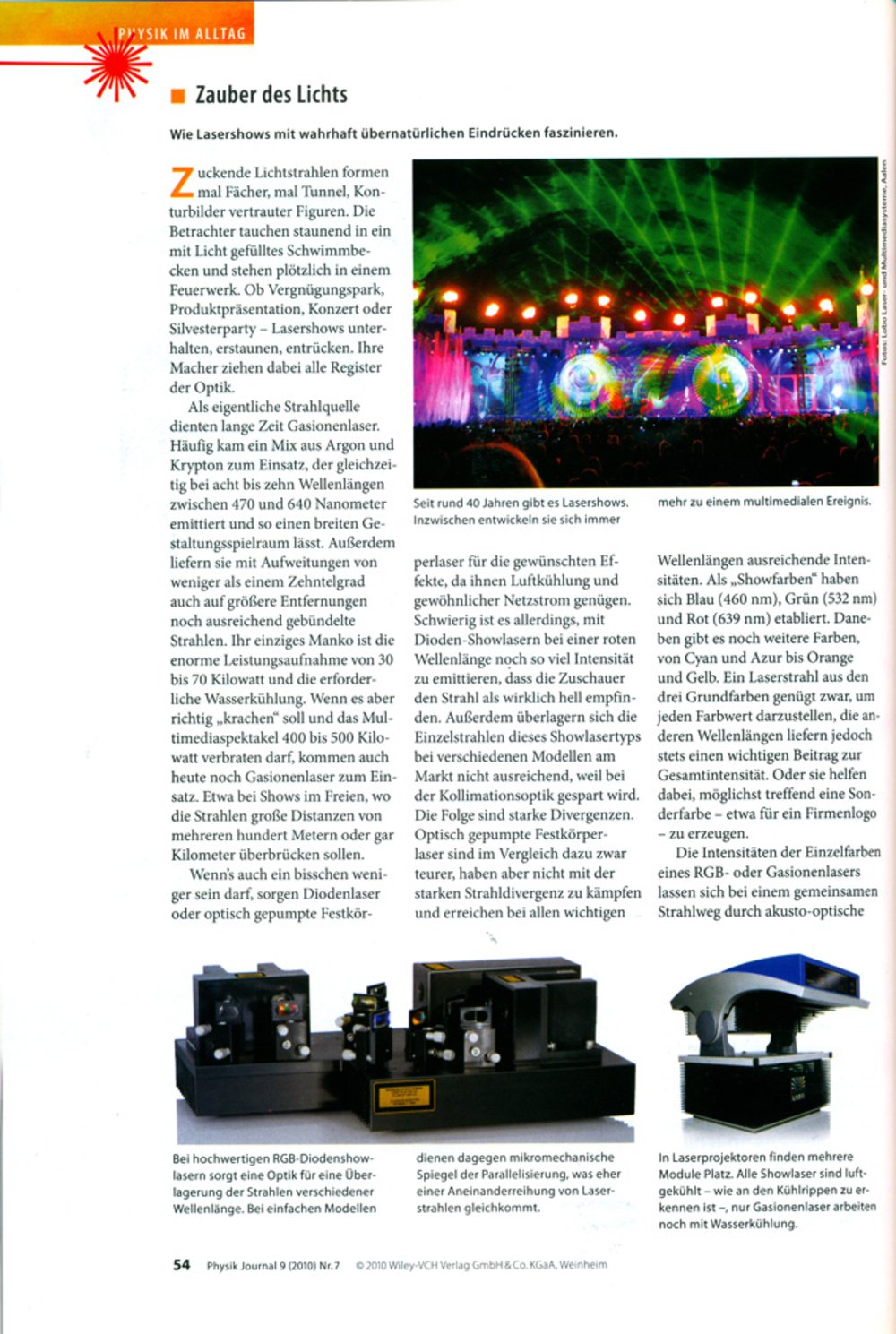
Darting beams of light form fans, tunnels, or contours of familiar shapes. Amazed, the spectators delve into a pool filled with light and suddenly find themselves standing in a firework. Be it in an amusement park, at product presentations, concerts or New Year’s Eve parties – laser shows entertain, amaze, and carry away. For this, their creators pull out all stops optics has to offer.
For the longest time, gas ion lasers served as the actual beam source. Often, a mixture of argon and krypton was used, being emitted simultaneously at eight to ten wave lengths between 470 and 640 nanometers and thus offering a broad freedom of design. Additionally, they provide sufficiently bundled beams even at larger distances thanks to widenings of less than one tenth of a degree. Their only downside is the enormous power consumption of 30 to 70 kilowatts and the necessary water cooling. However, if a veritable “boom” is desired and the multimedia event is allowed to consume 400 to 500 kilowatts, gas ion lasers are still used today. For example for outdoor shows, were beams may cover distances of several hundred meters or even kilometers.
If a little less is sufficient, diode lasers or optically pumped solid-state lasers provide the desired effects, as these only require air-cooling and regular mains power. However, it is difficult to emit enough intensity with diode show lasers at a red wavelength for the audience to perceive the beam as really bright. Furthermore, the individual beams of various models on the market of this show laser type do not overlay sufficiently because savings are made in the collimation optics. This results in strong divergences. In comparison, optically pumped solid-state lasers are more expensive, but do not have the problem of strong beam divergence and reach sufficient intensities for all important wave lengths. Blue (460 nm), green (32 nm) and red (639 nm) have become established as „show colors”. In addition, there are other colors from cyan and azure to orange and yellow. While a laser beam composed of the three base colors suffices to display any color value, the other wave lengths always provide an important contribution to the overall intensity. Or they help to create a special color as accurately as possible – for a company logo, for example. For a joint beam path, the intensities of individual colors of an RGB or gas ion laser can be adjusted with acoustic-optical modulators (AOM), in order to influence color and intensity of the overall beam. In an AOM, a sound wave is radiated into a crystal. This results in a modulated density profile moving at the speed of sound. With this, the refractive index inside the crystal varies periodically, leading to Bragg scattering at the resulting optical grid. For very simple laser show technology, intensity modulation is sometimes still effected with dichroitic filters, often composed of several thin, dielectric layers and only letting through certain wave lengths. This selectivity is based on the interference of direct and repeatedly reflected light. Here, the filters are swiveled mechanically into the beam path, which is far too slow for higher demands.
As the eye perceives a green beam as two or three times as bright as a red or blue one at 555 nanometers due to its maximum spectral sensitivity, an RGB laser system has to combine sources of varying intensity. Today, such models achieve several hundred to 2500 Watts per square meter at a distance of 200 meters. With this, high-value RGB laser systems, composed of several modules, reach intensities of up to 14,000 Watts per square meter and deliver sufficiently bright beams even after several mirror reflections and over large distances.
However, these are invisible per se. Hence, the show room is first filled with artificial fog, leading to Mie scattering: In contrast to Rayleigh scattering, the fog droplets, which are similar in size to the wavelength of the light, deflect it almost independently of the wavelength, but are strongly anisotropic – especially in the forward direction. Hence, if spectators look diagonally at a laser beam, whose source is in front or next to them, the beam appears brighter in the fog than if it would be directed away from the audience.
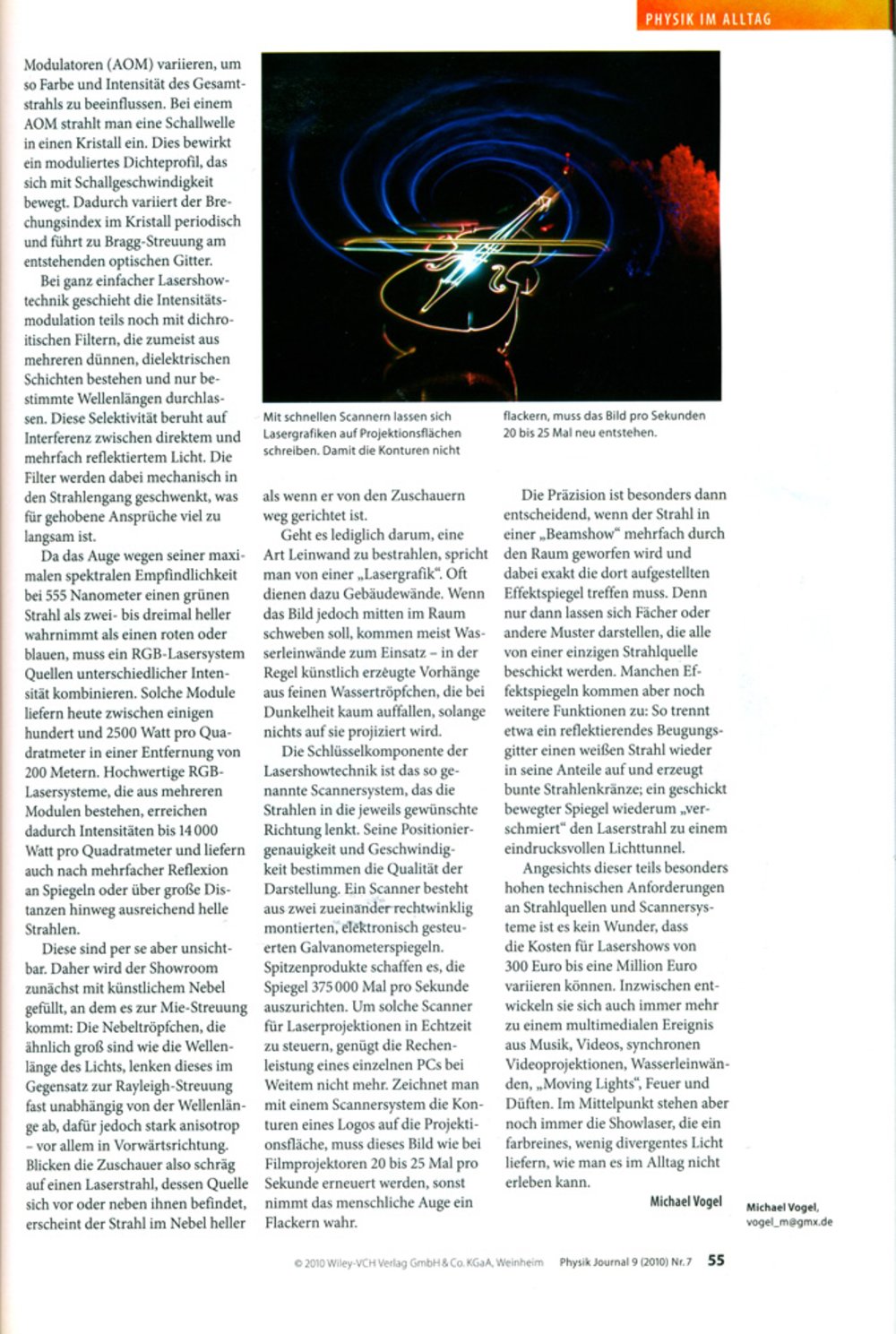
If only a projection onto some type of screen is required, the technical term is “laser graphic”. Often, building facades are used for this. However, if the image is supposed to float in the center of the room, water screens are often used – in general, these are artificially created curtains of fine water droplets; these are almost invisible in darkness, unless something is projected onto them.
The key component of laser show technology is a so-called scanning system, directing the beams into any desired direction. Its positioning accuracy and speed are decisive for the quality of the projection. A scanner consists of two orthogonally mounted, electronically controlled galvanometer mirrors. High-end products are capable to realign the mirrors 375,000 times per second. In order to control such scanners for laser projections in real-time, the computing power of a single PC is far from enough. If you draw the contours of a logo onto the projection surface with a scanning system, this image has to be updated 20 to 25 times per second, as with film projectors, as the human eye would otherwise see a flickering.
This precision is of particular importance when the beam is thrown through the room several times in a "beam show" and has to hit the effect mirrors set up there exactly. Only then, fans or other patterns fed by a single beam source can be shown. Some effect mirrors also have additional functions: For example, a reflecting diffraction grating may separate a white beam into its segments and generate colorful beam wreaths; on the other hand, an elaborately moved mirror may “smear” a laser beam into an impressive light tunnel.
Small wonder that the costs for laser shows vary between EUR 300 and up to one million Euros in light of these high technical requirements for beam sources and scanning systems. In the meantime, they have developed into an increasingly multimedial event, combining music, videos, synchronous video projections, water screen, „Moving Lights“, fire and scents. However, show lasers are still the centerpiece, delivering a pure-color light with little divergence that is unheard of in everyday life.