Media reports
Video January 2013
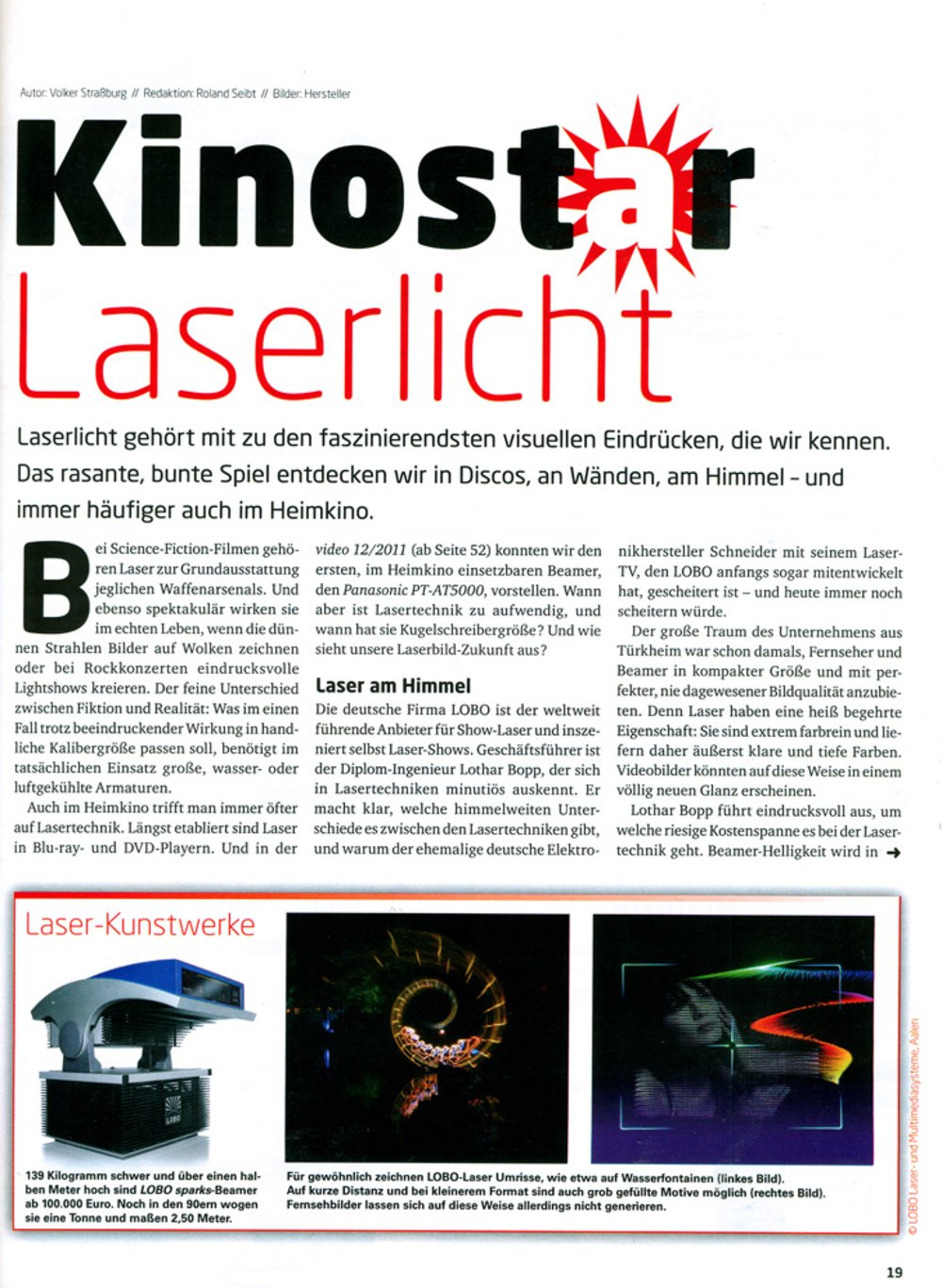
"Movie star laser light"
![[Translate to English:]](/fileadmin/user_upload/_processed_/2/0/csm_Banner_Video_01.2013_Titel_13be59fec7.jpg "[Translate to English:]")
Laser light is among the most fascinating visual impressions known to us. The fast-paced, colorful effects can be found in discotheques, on walls, in the sky and, increasingly, also in home cinemas.
In science fiction movies, lasers are an essential part of any weapons arsenal. In real life, they are just as spectacular, when thin beams paint images into the clouds or create impressive light shows at rock concerts. The subtle difference between fiction and reality: What fits into a handy caliber size in one case, despite its impressive effect, requires large, water- or air-cooled fittings in actual use.
Laser technology is also increasingly common in home cinemas. Laser in Blu-ray or DVD players has been established for a long time now. An in video 12/2011 (p. 52), we were able to present the first beamer for use in home cinemas, Panasonic PT-AT5000. But when is laser technology too complex and when does it have the size of a pen? And how does the future of laser images look like?
Laser in the skies
The German company LOBO is a globally leading supplier of show lasers and also produces its own laser shows. Its CEO, the graduate engineer Lothar Bopp, has in-depth expertise of laser technologies. He illustrates the vast differences between laser technologies and explains why the former German electronics manufacturer Schneier failed with its LaserTV, which was initially even co-developed by LOBO, and would still fail today.
Even at the time, the big dream of the company from Türkheim was to offer TVs and beamers in compact size and with perfect, unrivalled image quality. After all, lasers have a highly coveted feature: They are extremely color-pure, thus delivering extremely clear and deep colors. This way, video images can appear in a whole new brilliance.
Vividly, Lothar Bopp explains the enormous cost range involved in laser technology. Beamer brightness is measured in ANSI Lumen and professional projectors are easily able to achieve 5,000, with their costs being in the range of EUR 1,000. “At most, Schneider’s lasers also achieved 5,000 Lumen, but cost EUR 500,000,” Bopp emphasizes.
This already describes one of the main challenges of the technology: Today, generating a laser is not difficult, but making it sufficiently bright for video images is – event though flashes from laser show cannons appear dazzlingly bright and can even paint images onto far away clouds. But this range of projectors works differently. Only the contours of images and text are painted by a single, color-shifting laser beam. It is directed by a mirror, which can be moved rapidly via computer controls. In this case, “high end” means that the contours are painted approx. 30 times per second with 375,000 pixels. “On the other hand, the Schneider laser was to produce a conventional TV image,” expert Bopp clarifies. This means: Not only the contours have to be drawn, but completely filled out images, which are built up line by line as usual with videos. For 576 lines, this means almost 600,000 pixels – 50 times per second. This is a whole other dimension. And as the available light has to be distributed among much more pixels, the brightness per pixel is reduced drastically.
Even with the current state of the art – ten years after Schneider – Bopp still believes that the efforts for such a concept are far too high. “Since then, we have improved by about the factor four.” This means: 5,000 ANSI Lumen will cost about EUR 125,000.
It gets easier on a smaller scale
According to the prior state of the art, the projectors presented by Schneider Technologies in the 90s worked with imposing laser canons and were designed for rather faraway, large projection surfaces. They required high-quality lasers with a strong focus for optimally focused pixels, the expert from Lobo explains. For smaller distances, as those travelled by the beam of a home cinema rear projector, the focusing requirements are less strict. Additionally, the lasers require significantly less brightness. With modern know-how, these conditions have led to the construction of much smaller lasers. Large, complex gas ion lasers with water- or air-cooled glass bulbs evolved into compact solid state DPSS technology (Diode Pumped Solid State).
The laser is generated through collaboration of invisible infrared light as an energy source and a crystal. The infrared light is directed (“pumped”) into the crystal, which is illuminated by the supplied energy. Clamped between two mirrors, the light inside the crystal switches back and forth, becoming increasingly stronger. Additionally, a certain lighting direction is forced onto it, making it increasingly focused. Once it has reached the desired high intensity, it exits through one of the two mirrors as a directionally stable, strongly focused laser beam. This is the reason for the name “Light Amplification by Stimulated Emission of Radiation”; or LASER for short. Researchers are still experimenting and tinkering with it.
The composition of the specifically cultivated crystals, the interaction of infrared light and the crystal, and the changing of light wavelengths are the current areas of research.
But even with this technology, the light output is still too cost-inefficient for wide applications in home cinema beamers – at least as of now.
This is different for “diode lasers” as a significantly more affordable alternative. Instead of infrared light as energy source, a simple electric current is “pumped”, which flows through the crystal. While the resulting laser light is much less focused and bright as with the DPSS approach, it is sufficient for applications such as laser pointers, Blu-ray players and even beamers.