Media reports
Sigert's Fachmagazin für die Unterhaltungs-Gastronomie October 1989
"How a SIGERT editor was taught how to program a laser show. Not bad: Only five minutes for a segment with 15 steps"
![[Translate to English:]](/fileadmin/user_upload/_processed_/9/9/csm_Banner_Siegert_Nicht_schlechtb_04d7112019.jpg "[Translate to English:]")
“A magic dwells in each beginning,” the German poet Herrmann Hesse once said. I seriously doubt that he would have said the same thing, had he sat in front of a high tech laser controller worth about DM 100,000 for the first time, as I did recently.
On the other hand, it quickly became apparent that the proverb “Every beginning is hard” no longer had the highest priority in my personal collection of philosophical mumbo-jumbo. Actually, it was quite easy. I am almost inclined to use the word “simple” in this context…
At disctotec 1988 in Düsseldorf, the company LOBO electronic (owner: graduate engineer Lothar Bopp) presented its laser controller “LACON-3”. “LACON-3” uses a technology, previously only applied by a handful of specialists in high tech sectors such as the aerospace industry: transputers. For entertainment electronics, the use of a transputer still remains a novelty to this day. A transputer is a high-performance computer with parallel interconnectivity, processing ten million mathematical operations per second. Consequently, six of these units within the “LACON-3” system are able to perform 60 million mathematical operations per second. This approximately corresponds to the capacity of 1,000 conventional PCs. “And that is enough?!”, one wants ask almost ironically. Lothar Bopp: “There are complex three-dimensional figures, making full use of even this enormous computing capacity.”
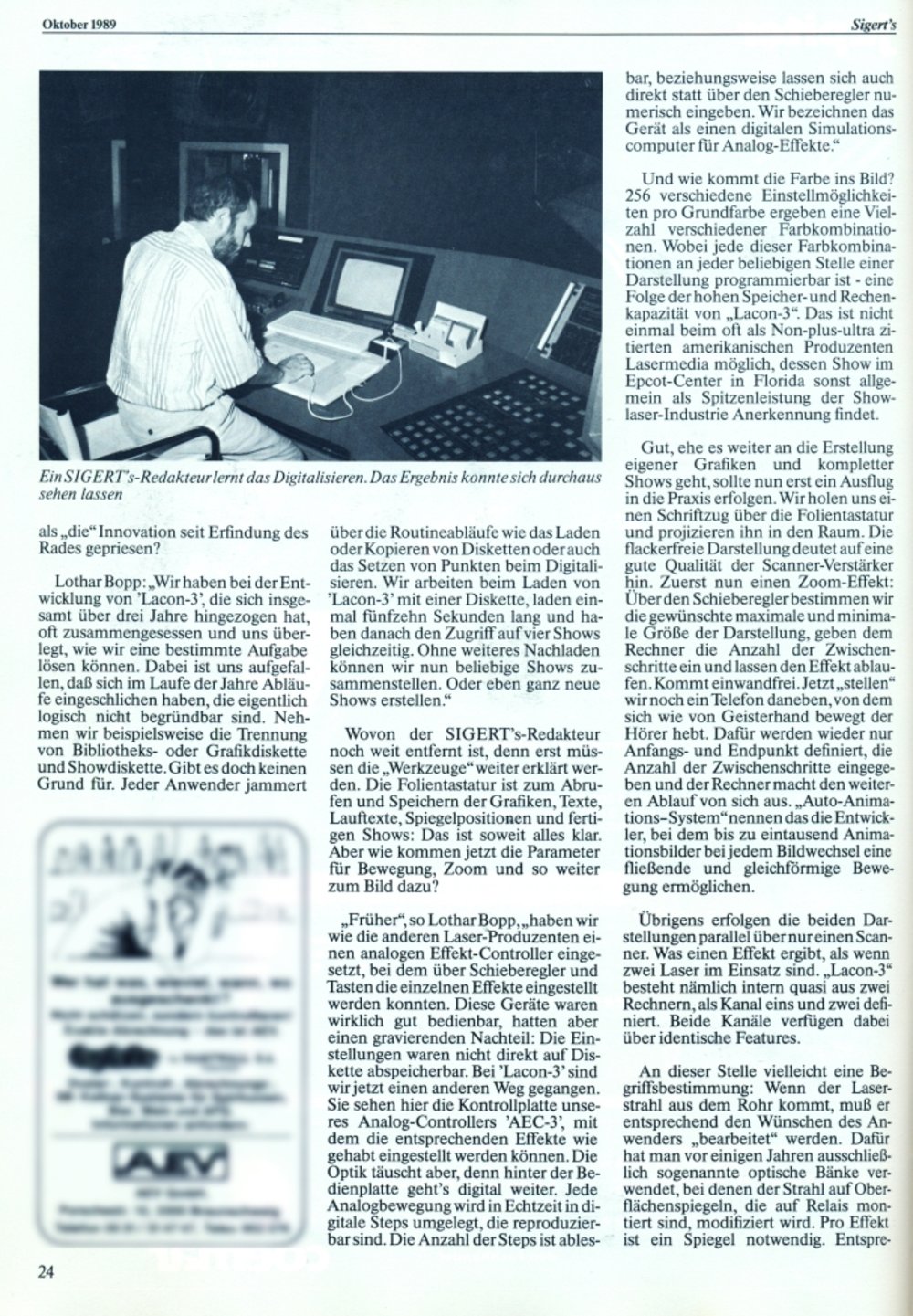
However, the development team, consisting of six graduate engineers, did not only want “LACON-3” to have fast processing power, but also wanted it to be easy to operate. SIGERT's intended to put this to the test and got and introduction to the computer. Was operation really that simple? At first glance, LACON-3 is nothing special: housing, membrane keypad, above a controller with slide controls, screen, alphanumerical keypad, joystick... The “devil” has to be in the details. Graduate engineer Werner Most, one of the LACON-3 developers, begins his instruction with the membrane keypad: “We have direct access to 240 graphics, four times more than with the previous model. In addition, 40 texts, twelve scrolling texts as well as 240 mirror positions are directly accessible via multifunctional keys. We can display 32 letters with a scanner and color and position each letter individually. Blanking is done automatically.”
Let’s slow down a bit: Will this be like in the automotive industry? Three more HP and a follow-up model is lauded as “the” innovation since the invention of the wheel?
Lothar Bopp: “During the three years of development time of LACON-3, we often sat together and discussed how we could solve a certain task. We noticed that certain processes had become commonplace over the years that did not make any logical sense. Take for example the separation of library or graphic diskette and show diskette – there is no reason for that. Every user complains about routine processes such as the loading or copying of diskettes or setting of points during digitalization. In order to load LACON-3, we are working with one diskette, load once for fifteen seconds and then have access to four shows simultaneously. Now, we can put together any desired show without reloading. Or even create entirely new shows.”
The editor from SIGERT’s is still a long way off from that, as the “tools” need to be explained first. With the membrane keypad, graphics, texts, scrolling texts, mirror positions and completed shows can be retrieved and stored – so far, so good. But how are the parameters for movement, zoom etc. now added to the image?
Lothar Bopp: “Previously, we used an analogous effect controller, just like other laser producers, where the individual effects could be set via slide controllers and keys. While these devices were really easy to handle, they had one serious disadvantage: These settings could not be stored directly on a diskette. We went down a different path with LACON-3. Here, you can see the control panel of our analogous controller “AEC-3”, with which the corresponding effects can be set as usual. However, the optics are deceiving, as there is a digital continuation behind the control panel. In real-time, each analogous movement is converted into reproducible digital steps. The number of steps can be read or they can be numerically entered directly via the slide controller. We are calling this device a digital simulation computer for analogous effects.”
And how does color come into the picture? With 256 different setting options per base color, there is a multitude of different color combinations. And any of these color combinations can be programmed at any position of an image – thanks to the high storage and processing capacity of LACON-3. This is not even possible for the American producer Laser Media, often named the non-plus-ultra, whose show in the Epcot Center in Florida is otherwise generally considered as peak performance in the show laser industry.
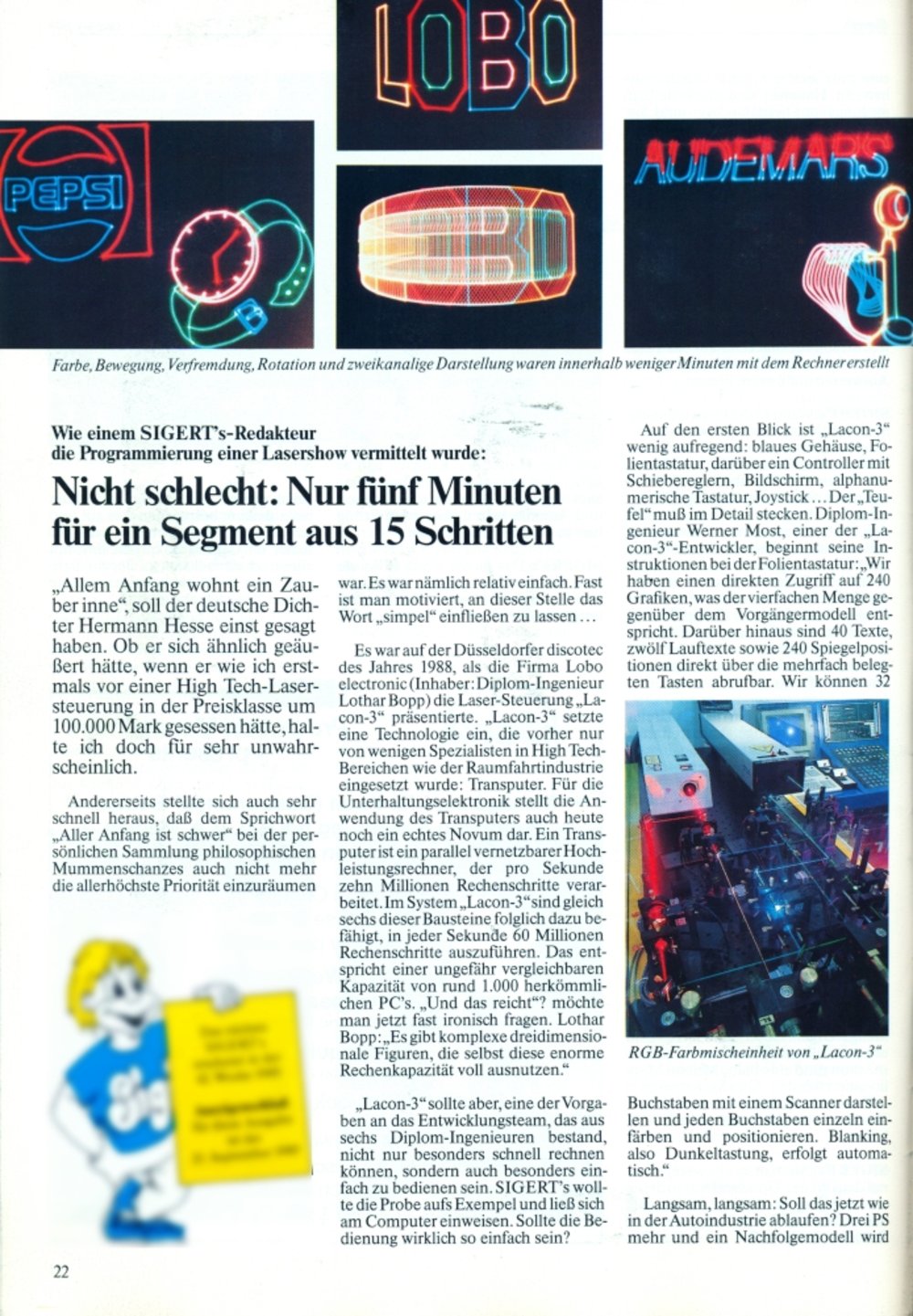
But before continuing on to the creation of own graphics and entire shows, a practical excursion is set to take place. With the membrane keypad, we take some lettering and project it into the room. The flicker-free image is testament to the good quality of the scanner amplifiers. First, we add a zoom effect: With the sliders, we determine the maximum and minimum size of the image, enter the number of intermediate steps into the computer and let the effect play. Works perfectly. Now we also add a telephone, with the receiver moving as if by magic. For this, we once again only have to define a starting and an endpoint, enter the number of intermediate steps, and the computer takes care of all the rest. The developers named this an “auto-animation system”, with up to one thousand animated images for each image change allowing for a fluent and consistent movement.
Incidentally, the two images are displayed in parallel using just one scanner. This produces an effect as if two lasers were in use. Internally, LACON-3 consists of two computers, defined as channel one and two, with both channels having identical features.
Here, a definition might be appropriate: When the laser beam comes out of the tube, it has to be “processed” according to the wishes of the user. Until some years ago, only so-called optical banks were used for this, with the beam being modified on surface mirrors mounted on a relay. For each effect, one mirror is required. Accordingly, a 20-fold optical bank produced 20 effects. Newer laser beam processing technology uses a scanner consisting of a miniature surface mirror mounted on a torsion bar, which is guided by two coils through which current flows. With a scanner, the beam can be positioned quicker and more precisely. As long as there are no aberrations caused by temperature fluctuations. Today, the scanners are heated in order to always have consistent conditions. The scanner pair of LACON-3 is consistently held at a temperature of 40°C by an encircling heating tape.
For the image quality, the so-called image resolution also plays a role. Normally, it is 8 bit. LACON-3 has improved this and works with a resolution of 16 bit. This corresponds to four billion freely selectable points in space, from which the image is ultimately composed. So far, so good. After having loaded, retrieved, modified, animated, colored and stored graphics, we are now supposed to create our own graphics and then design a music-synchronous show. After all, you do not only want to manipulate or edit existing images as a user. In order to create graphics, a graphic tablet is generally used. In this process, points are set with a kind of pen, which the laser beam scans so quickly that seemingly fixed images are created.
With conventional systems, many points are set in corners and few points are set in straights, requiring a sufficient amount of diligence more than actual artistic talent. With LACON-3, only a few corner points have to be set. The rest is once again completed by the computer, adding its own points between the manually set points. In the end, each graphic is composed of 50,000 points. A homogenous image is only made possible by the multitude of points.
After having created the SIGERT’s logo on the graphic tablet within a few minutes, the compilation of a short sequence was next. I decided on the logo, had it rotate three-dimensionally around an imaginary cylinder and gave each letter a different color. Then I switched to a radio, had it extend its antenna and play a note from its speaker. I continued with the previously described telephone receiver and a rotating color circle, slowly turning into a psychedelic effect. Including all intermediate steps, the sequence had 15 segments in the end.
Then, some music was added, the individual steps were temporally defined by pressing the space key and thus automatically saved on the diskette with the corresponding information within tenths of a second. And because I hadn't “stepped” one hundred percent accurately due to excitement or distraction, I was able to “tweak” it afterwards by changing the switching time as required. This was facilitated by a synchronization timecode created autonomously by the computer, recorded on tape along with the music. All changes and interventions are made directly on a digital level without the need for complicated re-recording to tape. In the end, the shows can be controlled manually, automatically synchronized to the music or synchronized to the music.
Done! Fifteen steps in five minutes. Duration of the entire training, including appropriate explanations on the technical background: about two hours.
It was meant as an experiment and should be viewed as such. After all, the quick introduction with concluding show or sequence creation can only touch upon the periphery of the possibilities of this high tech laser controller. In the end, the seamless menu navigation of LACON-3 supports human curiosity and thus facilitates many previously unknown effects. This is reinforced by the fact that LACON-3 is a fully functional unit for show creation, with nothing missing apart from the recorder for the music.
For this, LACON-3 consists of the following components: computer unit with floppy station, digital storage and synchronization system, analog effect simulation computer, four waterproof membrane keypads, alphanumeric keypad, joystick, three scanner amplifiers, graphic tablet, a graphic scanner pair, an RGB color mixing unit, a software package with operating system and handbook, finished shows and graphic library and the color monitor.
Conclusion: The goal had been reached and the results were certainly presentable, as LACON-3 is easy to operate with the screen menu navigation. The controller has a high price, but is not advertised as a cheap product by its manufacturer. A lot of high tech for a lot of money, one is inclined to say. Anyone looking for an affordable device to playback standard laser shows with little or no interference capabilities should not opt for LACON-3. While the manufacturer and some specialized laser designers offer completed shows for this controller, this is not the application focus of LACON-3; rather, it is meant for creative and interested users in the theater, movie and industrial sector or in large discotheques, wanting to conjure up professional shows. But then, the results can be absolutely remarkable.