Media reports
creativ collection 2011
"Special Events"
![[Translate to English:]](/fileadmin/user_upload/_processed_/7/2/csm_Banner_Creativ_collection_2011_7400a39b65.jpg "[Translate to English:]")
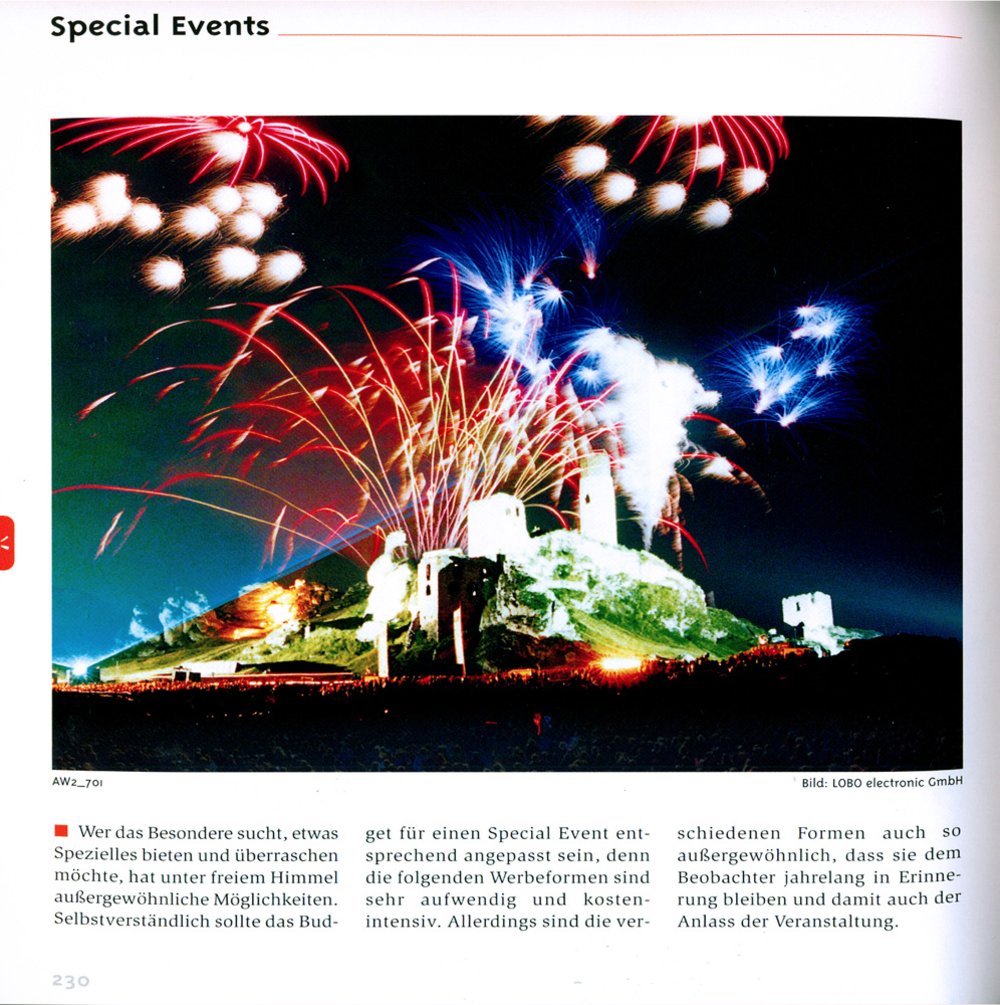
Outdoors, those looking for something particular, wanting to offer something special and wanting to surprise, have extraordinary possibilities. Obviously, the budget for a special event has to be adapted accordingly, as the following means of advertisement are rather expensive and cost intensive. However, the various possibilities are so extraordinary that they – and therefore the occasion for the event – will stay in the minds of spectators for years.
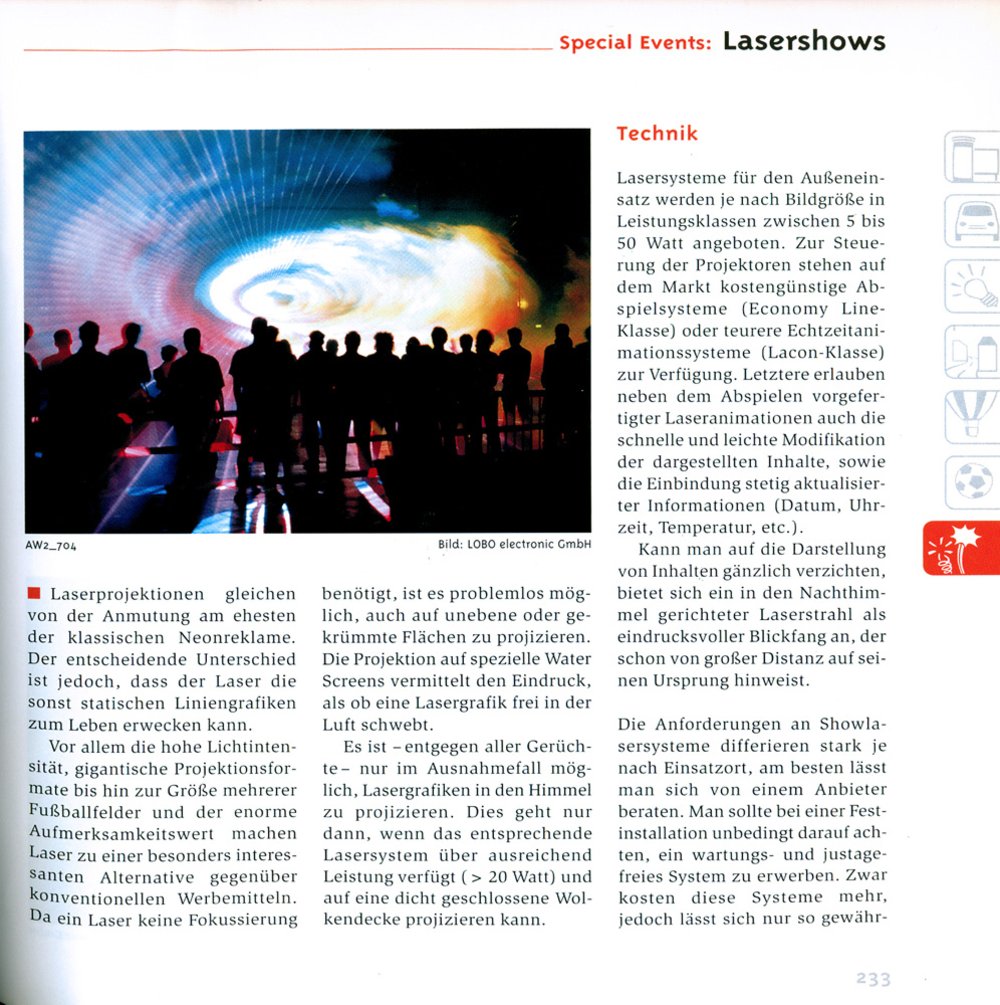
From their appearance alone, laser projections are most similar to conventional neon advertisements – with the main difference being that laser can bring the otherwise static line graphics to life.
In particular, its high light intensity, gigantic projection formats up to the size of several football fields, and the enormous attention value make laser an interesting alternative to conventional advertisement means. As laser does not require focusing, it can easily be projected onto uneven or curved surfaces. Projections onto special water screens give the impression of laser graphics hovering freely in the air.
Contrary to rumors, laser graphics can only be projected into the sky under exceptional circumstances. This is only possible if the corresponding laser system has sufficient power (> 20 Watts) and can project onto a closed cloud cover.
Technology
Depending on the image size, laser systems for outdoor use are offered in performance classes between 5 and 50 Watts. For the control of the projectors, both affordable playback systems (Economy Line Class) as well as more expensive real-time animation systems (Lacon Class) are available on the market. In addition to the playback of pre-made laser animations, the latter also allow for quick and simple modification of displayed content as well as the integration of constantly updated information (date, time, temperature etc.).
If the display of content is not required at all, a laser beam directed into the night sky can be an impressive eye-catcher, directing to its origin even from far away.
The requirements for show laser systems differ considerably depending on the operation site. It is best to get consultation from a supplier. For a permanent installation, it is paramount to opt for a maintenance- and adjustment-free system. While these systems may be more expensive, this is the only way to ensure reliable functionality of the system without daily, labor-intensive re-adjustment. In case of a fault, integrated, multiple safety systems should automatically switch off the entire system so that people cannot be harmed by uncontrolled escaping laser radiation.
For permanent installations, permits must be obtained from the municipal administration. Before being put into operation, the radiation safety of a laser system has to be assessed by an independent expert. When the projector can project onto a large surface, the cost-effectiveness of laser advertisements is unbeatable. In principle, it does not matter whether the surface is rough or smooth, dark or light, even or curved.
Furthermore, it is technically insignificant whether the application takes places indoors or outdoors. The only exception are strongly reflective surfaces, which are unsuitable for laser projections.
Format
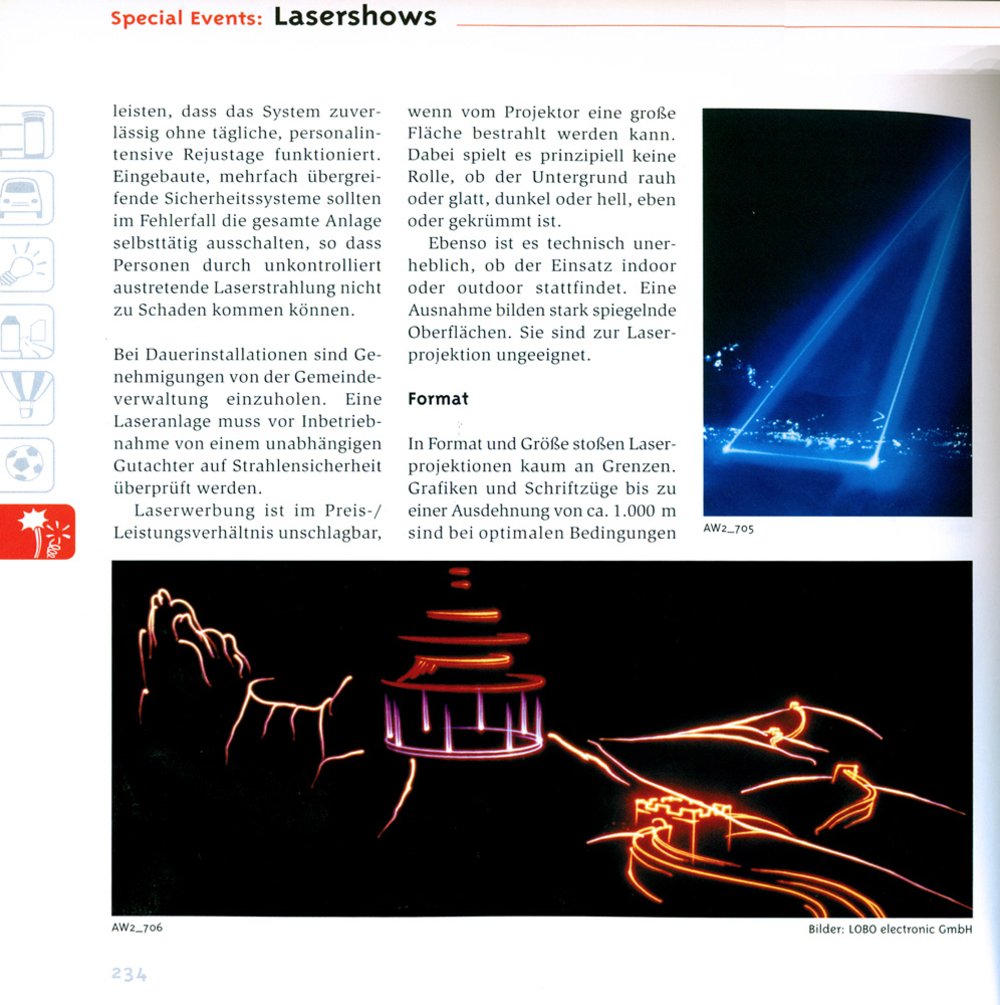
Laser projections barely have limits when it comes to shape and size. Under optimal conditions and with sufficiently powerful laser systems, graphics and slogans up to a size of about 1,000 m² are no problem. Modern laser systems can project graphics in all colors.
However, the complexity of the displayable graphics is limited due to the vectorial image output. The display of a too complex image results in a clearly visible flickering of the laser graphic. This can be remedied by using an additional laser projector.
For an optimal display, it is important that the distance between laser projector and image is not smaller than the maximum image extension and does not exceed the image width by a factor of five or more.
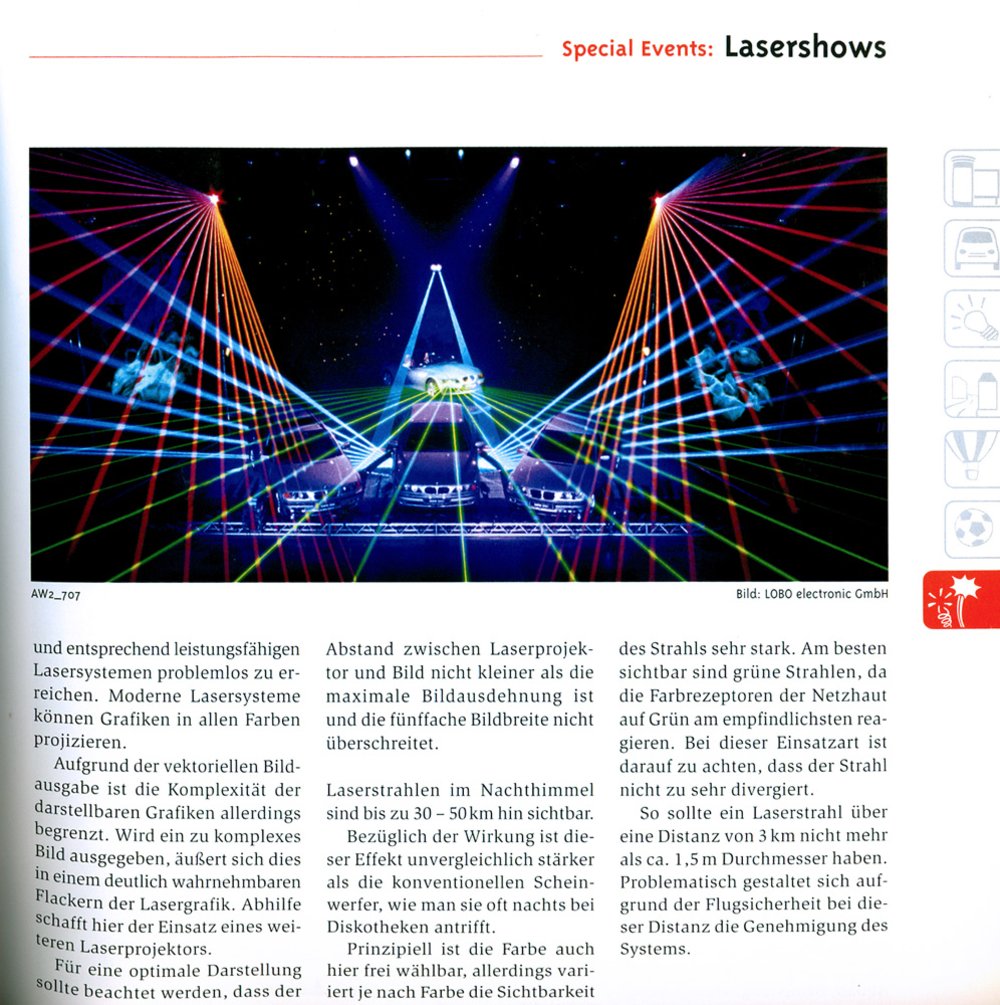
In the night sky, laser beams are visible for up to 30 - 50 km. In terms of impact, this effect is incomparably stronger than conventional spotlights, as can be often found at night in discotheques. In principle, the color can be selected freely. However, the visibility of the beam varies quite strongly depending on the color. Green beams have the best visibility, as the color receptors of the retina react most sensitive to green. For this application, it is important that the beam does not diverge too strongly.
For example, a laser beam should not have a diameter of more than approx. 1.5m over a distance of 3km. Due to aviation safety, it might be difficult to get a permit for a system with such a distance.