Media reports
Production Partner Fachmagazin für Veranstaltungstechnik August 1998
"Lobo Lacon-5"
![[Translate to English:]](/fileadmin/user_upload/_processed_/a/3/csm_Banner_Production_Partner_84097c2270.jpg "[Translate to English:]")
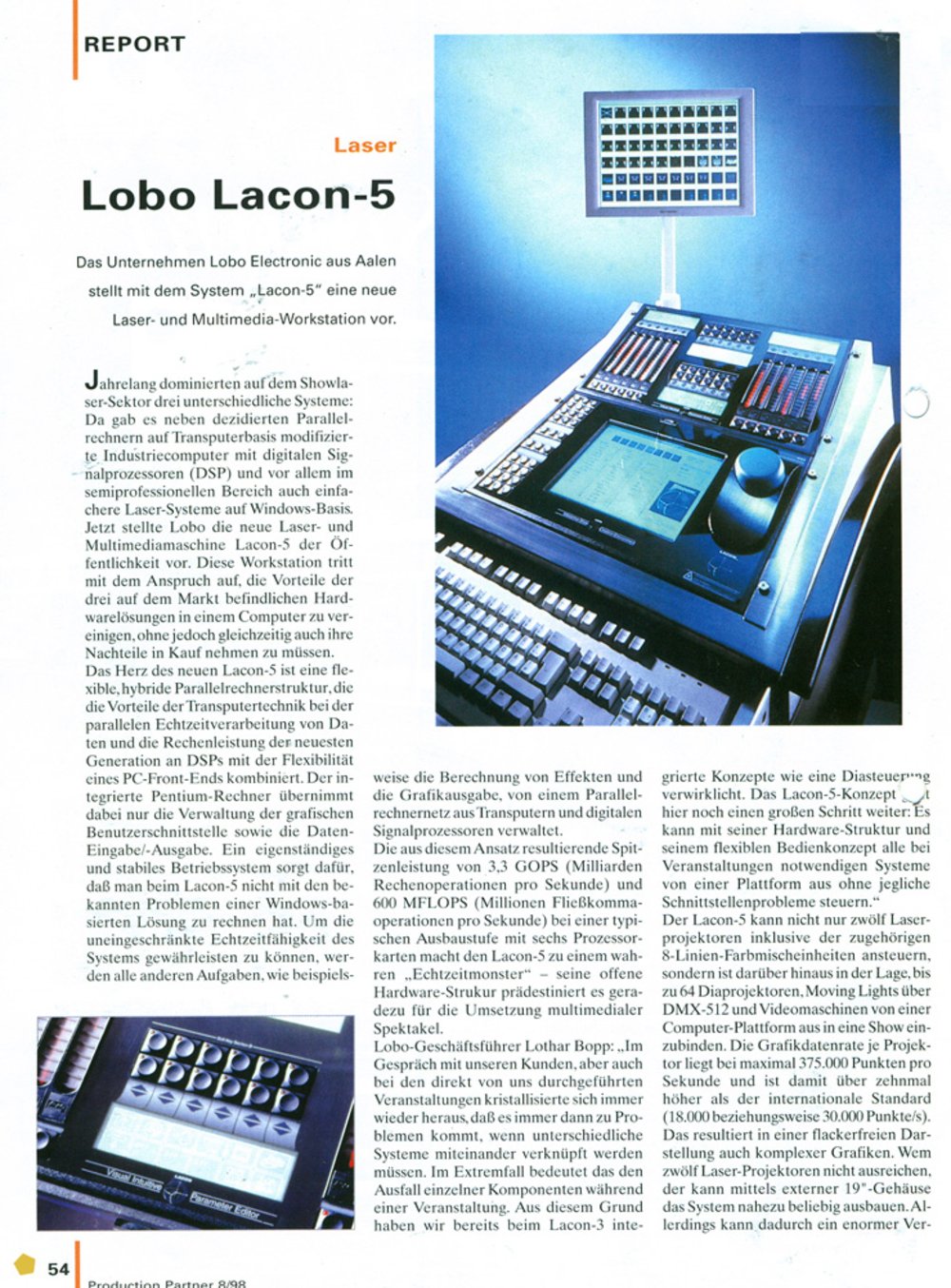
With the system “LACON-5”, the company LOBO electronic from Aalen presented a new laser and multimedia workstation.
For years, the show laser sector had been dominated by three different systems: In addition to parallel computers, there were transputer-based modified industrial computers with digital signal processors (DSP) and, in particular in the semi-professional field, more basic Windows-based laser systems. Now, LOBO presented the new laser and multimedia machine LACON-5 to the public. This workstation aims to unite the advantages of the three hardware solutions available on the market in one computer, without having to accept their disadvantages. At the heart of the new LACON-5 is a flexible, hybrid parallel computer structure, combining the advantages of the transputer technology, such as parallel real-time processing of data and computing power of the newest DSP generation, with the flexibility of a PC front-end. The integrated Pentium computer only takes over the administration of the graphic user interface and data in-/output. With its autonomous and stable operating system, LACON-5 does not have the same problems as Windows-based solutions. In order to ensure the unrestricted real-time capability of the system, all other tasks, such as the calculation of effects and graphic output, are administered by a parallel computer network of transputers and digital signal processors.
With this approach, a peak performance of 3.3 GOPS (billion computing operations per second) and 600 MFLOPS (million flow command operations per second) for a typical expansion level with six processor cards can be achieved, turning LACON-5 into a veritable “real-time monster”. Its open hardware structure basically predestines it for the realization of multimedia spectacles.
LOBO’s managing director Lothar Bopp: “Both in talks with our clients as well as during events realized by us, it became more and more apparent that there were problems when different systems were to be connected with each other. In extreme cases, this meant the failure of some components during an event. For this reason, we have realized concepts already integrated in LACON-3, such as a slide controller. The LACON-5 concept takes this one step further: With its hardware structure and its flexible operating concept, it can control all systems required for an event from one platform and without any interface issues. LACON-5 cannot only control twelve laser projectors, including the associated 8-line color mixing units, but is also able to integrate up to 64 slide projectors, moving lights via DMX-512, and video machines into a show from one computer platform. Each projector has a maximum graphic data rate of 375,000 points per second, ten times more than the international standard (18,000 or 30,000 points/s). This results in a flicker-free display of even the most complex graphics. If twelve laser projectors are not enough, the system can be extended almost indefinitely with external 19” housings. However, this might result in an enormous wiring effort, requiring a lot of time and money, in particular in the rental business. In the laser industry, it is common to supply each laser projector with about eight to ten separate signal lines (x/y signal and control signals for color mixing) and numerous signal cables to control an optical bank. Even if the operator uses special multicore cables, it might be easier to find the proverbial needle in a haystack than locating the reason for a transmission error within such a system. Not to mention the safety-relevant issues with electromagnetic interferences in the tangled mess of cables.
In order to master this problem in advance, LOBO has developed a digital signal transmission concept for LACON-5 under the name of Digital Data Link (short DDL). Digital Data Link is an extreme wideband data bus, consisting of a single fiber optic cable and able to connect all components of a laser system in virtually any desired sequence. Any connected device knows exactly which of the transmitted signals have to be “fished out” from the data stream; the rest is simply forwarded to the next link in the fiber optic chain. As a positive side effect, the Digital Data Link forms a closed safety system, with each connected component being able to react with a safety shutdown of the whole system in case of a fault. If you also consider that the projectors developed by Lobo only have to be adjusted to the local conditions and external effect mirrors in the room by software and no longer mechanically, the installation and commissioning of even larger laser systems is reduced from a couple of days to a few hours.
With the serially integrated MIDI interface, it is possible to control the whole machine live with a regular MIDI keyboard. In addition, the system offers 40 digital in- and outputs as well as eight serial interfaces to interactively influence the program sequence and control peripheral equipment such as screens, fog generators or pyro effects. With the announced hard disk option, the sound for the show will soon no longer have to be recorded, but can be taken directly from the hard disk of the workstation. The system has a modular design so that the user's wallet is not strained by unnecessary options. If an additional laser projector needs to be controlled, it is sufficient to equip the system with an additional output module. The same applies for the DMX board and the slide option. LOBO also broke new ground in the field of user guidance. As an alternative to a conventional mouse-based interface, Lacon-5 also offers an interactive show creation environment with pen-based graphic user interface. Head developer Grad. Eng. Werner Most said: “For the user interface, we took care that users do not need to navigate through dozens of windows or lose a lot of time with fully stuffed parameter fields, as is the case with conventional systems. In principle, the laser show designer will treat the device as a piece of paper and simply draw with a pen on the integrated monitor or intuitively place and edit three-dimensional objects with the built-in 3D puck. Any features not directly needed for your work are outsourced to a second LCD monitor. In order to allow for a quick access to the most important parameters during programming and shows, we also offer a parameter editor with four backlit LCD displays that can assign different functions to 24 soft keys and twelve LED-backlit sliders.” Even untrained laymen without great creative skills can reach their goal quickly and intuitively.
The base price for a Lacon-5 workstation including a 13.8“ TFT monitor is around DM 60,000. Considering its performance capabilities, this price isn’t too high. An expansion module for an additional projector costs a little over DM 10,000. Additional funds are needed for the DMX control, the slide module SCS-5, the hard disk option or for the input console for additional programming comfort. If required, all additional components can be added at any time. As usual, owners of a Lacon-3 or Economy-Line laser system from LOBO will have access to an affordable upgrade and exchange program for the new system.